
Key Changes to FIRST Robotics Competition Registration: What’s New
June 17, 2026
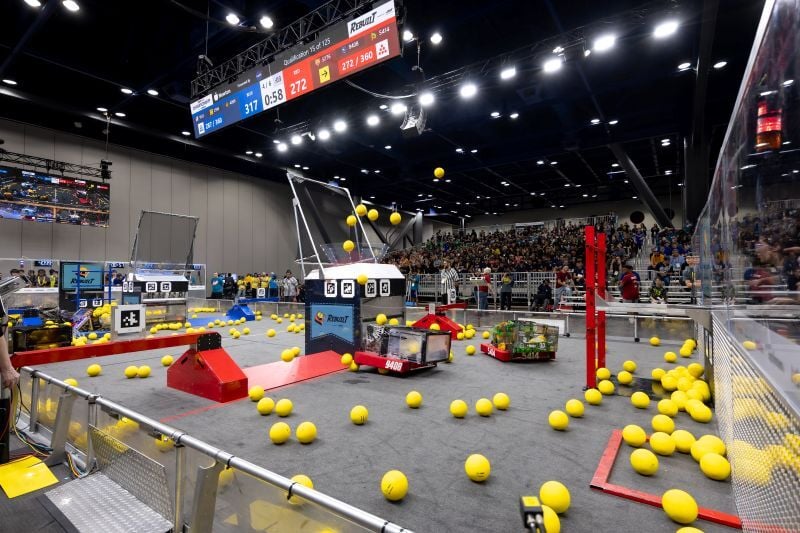
During the 2026 FIRST® Championship presented by BAE Systems, we found that several matches on the Newton field had incorrect match lengths. We wanted to provide more information about this issue, how it came about, and how we’re moving forward.
Summary
After Newton Match 35, FIRST staff became aware of an issue that made matches last longer than expected. FIRST staff were able to identify and mitigate the issue for Qualification Matches 64 through 125 and the Playoff Matches (i.e. all Matches on Friday and Saturday).
Upon further investigation, more matches were impacted by this than we originally thought. The root cause of the issue has been identified, and a temporary fix has been put into place for off-season events. FIRST staff are working on a more comprehensive fix to the issue for next season.
Thank you to the volunteers, mentors, and students for handling a difficult situation with grace even when the stakes were high. Everyone involved cares deeply about the quality of our events, and it’s a testament to our community's culture that we can be passionate and understanding.
The Backstory
In previous years, the Field Management System (FMS) code had a match timer service that would send out a “match time remaining is X” message to the rest of the system. (More detail about the FMS is available in this FMS Whitepaper.) Code for the physical timer signs on the alliance walls, the scorekeeper interface, the audience display, and other parts of the system all listened for this message and update displayed values accordingly. We later used this same service to support alliance selection timers and playoff break timers but had some reliability concerns with that approach. For 2026, we rewrote the timer service to more flexibly handle these additional needs. As part of this rewrite, the message changed from “match time remaining is X” to “decrement timer by 1 second”.
During Weeks 0, 1, and 2 of 2026, FIRST® Robotics Competition staff and volunteers did not observe or hear about any timing problems on the field. We did, however, see some behavior on a few fields in Week 2 in which late-arriving fuel at the very end of auto would be counted toward auto but after the system had already determined who won “advantage” from auto. FMS gets the fuel counts from a Programmable Logic Controller (PLC) in our scoring table roadcase. In this situation, the FMS desktop software was determining the winner before telling the PLC to transition to teleop. We put a fix in place so FMS would wait for the PLC to acknowledge that autonomous was completed, before determining advantage. This fix was deployed for Week 3 events. Unfortunately, this fix introduced a bug where this “handshake” would occasionally cause a delay of a few seconds between when the robots were enabled for teleop, and the timer began counting down. A handful of teams brought this to our attention during the Week 3 practice day, and the issue was resolved in time for qualification matches of Week 3 events.
In Week 3, we discovered that a robot with a “network loop” would cause that specific alliance station to stop working for all subsequent matches until the field access point was rebooted. We worked with Vivid Hosting and some of our FIRST Technical Advisors (FTAs) to try to resolve this via changes to our network device configurations during Week 4 but were ultimately unsuccessful. We reverted these specific network device configuration changes back to their original state from Week 3, and instructed FTAs how to watch out for this robot network loop issue.
Newton Matches
Fast forward to Thursday at the FIRST Championship in Houston. In the original Match 35 on the Newton field, all robots stopped moving during autonomous because the driver stations for all six teams were no longer receiving the enabled message from FMS. During this time, the field timers also stopped counting down. Based on initial debugging at the field that showed the head referee touch panel consistently losing connection, we believed this to be a network utilization problem on the wired side of the FMS network. We found a network switch in our scoring table roadcase that was still running the configuration we had attempted in Week 4, rather than the reverted configuration. We proceeded to revert that device to the proper configuration and then confirmed that all other fields were running the correct configuration. The decision was made to replay Match 35 due to the incorrect configuration.
Around that same time, a team approached the field crew and reported that their scouting data showed that some matches had run longer than expected. FIRST staff investigated the report using data logs from the Newton field and confirmed that multiple matches had durations longer than expected. Most of these matches took place in the morning, though a few also occurred in the afternoon. We then took the following steps:
That evening, a handful of FIRST staff and FTAs stayed at the venue late to try to determine the root cause of the issue. Initially thinking this was due to heavy network utilization, we started by trying to isolate whichever device on the Newton field network could be contributing. After a couple of hours spent disconnecting various devices one at a time, no culprit was found. At the end of this testing, we observed that the CPU utilization on the scoring computer running the FMS software was unusually high. Additionally, the FMS software includes an indicator that shows how long messages are taking to transmit between services within FMS, and this value was also observed to be much higher than expected. We restarted FMS services, and subsequent test matches ran for the correct duration. Digging into the code, we realized that if FMS services got “bogged down,” the new 2026 “decrement time by 1 second” messaging could cause extra match time. The previous approach, used in 2025 and earlier, would self-correct in this situation since the message included the absolute time value remaining.
After investigating the impact and root cause, FIRST staff determined the following:
We communicated this information to Newton teams on Friday morning after opening ceremonies. FIRST staff continued to monitor match durations via data logged in our systems and observed no affected matches for the remainder of the event.
What Are We Doing About It Going Forward?
FIRST staff dug into more data after the FIRST Championship to review the impact of the error. The outcomes of match timings across more than 20,000 practice, qualification, and playoff matches across all events this season are in the table below:
| Match Timing | Number of Matches |
| +1 second or less | 16,023 |
| +1 to +3 seconds | 3,247 |
| +3 to +5 seconds | 933 |
| +5 seconds or greater | 140 |
| Total | 20,343 |
We are taking several steps to address this issue going forward:
Wrapping Up
We know how much time, energy, and passion all teams put into their season, and how frustrating it can be when issues outside your control affect your event experience. We’re sorry that this issue happened, and we deeply appreciate the patience and professionalism of the teams and volunteers on the Newton field as we worked through this situation.