Introducing the FIRST A301
December 9, 2025
Today we're happy to share another update regarding the new control system for FIRST® Robotics Competition and FIRST® Tech Challenge. While previous control system blogs have focused on the component which will be used in both programs, Systemcore, this blog will focus primarily on how the new control system and surrounding technology will shape the future of the FIRST Tech Challenge program.
As a reminder, the new control system will be available to FIRST Tech Challenge teams to compete with starting in the 2027-28 season (FIRST Robotics Competition teams will start using the controller in the 2026-27 season). There will be a transition period through at least the 2030-31 season in which the legacy system and a hybrid approach will be legal to help make it easier for teams to upgrade over time. We understand that transitioning to a new control system can be an investment for teams, so we have designed this process to reduce and diffuse financial impact while maintaining a level playing field across both systems.
Our focus while developing the new control system has been to create technology parity between FIRST Tech Challenge and FIRST Robotics Competition, lower barriers to entry for getting started, reduce the feeling that teams need to buy additional hardware "just to keep up" — we've come to call this "Robo-FOMO" at HQ — and maintain comparable pricing to the current system. This focus required us to make many small decisions and trade-offs along the way; while we won't be able to explain every choice, we hope our team-first approach will become clear as we continue to share more details.
Starting with a high-level overview, the new FIRST Tech Challenge control system will consist of 5 main components which every robot will need:
Building a FIRST Tech Challenge robot is often a packaging challenge, so let’s start with a look at the space requirements for Systemcore and Motioncore side-by-side with the current control system. The image below shows Systemcore and Motioncore overlaid overtop of Control Hub and Expansion Hub and shows the significant reduction in controller footprint.
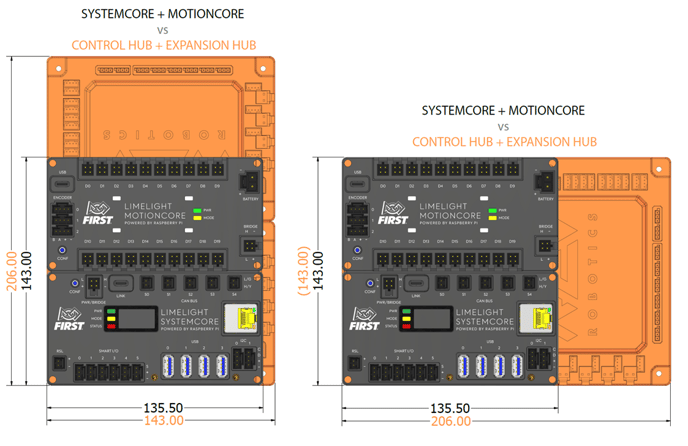
Control System Size (Footprint) Comparison
As well as considering robot packaging constraints, the new control system also prioritizes serviceability and reliability by reducing the number of cable types and total connection points. Nearly every connection on the new control system also uses a keyed (can only be plugged in one way) and latching connector.
In addition to the Molex Micro-Fit+ cables shown in the example below, the new system also uses Molex SL connectors for quadrature encoder inputs on Motioncore and other sensors on Systemcore. Molex SL is a keyed latching replacement for the commonly used “PWM Extension Cables”. Fewer types of cables means less money spent on unique spares and teams are more likely to have the right spare on hand.
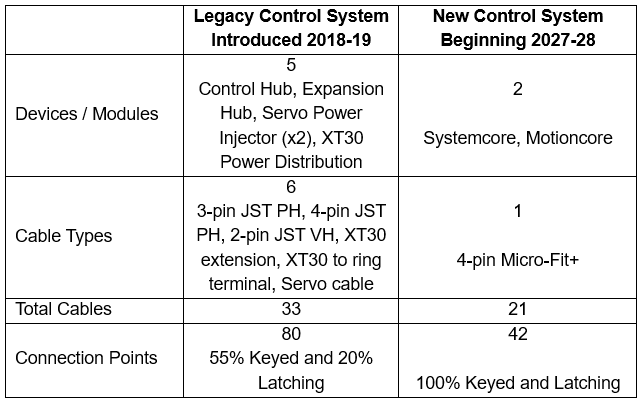
It is difficult to compare the old and new system with every possible combination of use cases and devices. The example in the table below includes required devices and connections to power 20 high power actuators, assuming no sensors and excluding a battery solution.
Table of Devices and Connections for a Hypothetical 20 Actuator Robot
The image below is a visualization of the devices, cables and connections detailed in the table above. In reality, we know some teams will never use 20 actuators and many teams do use a significant number of sensors, so this just an example and is not all inclusive of all possible comparisons.
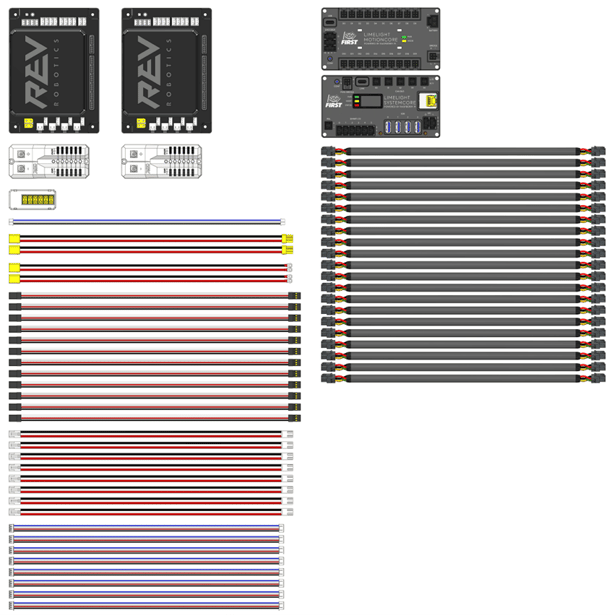
Control System cable comparison for a robot with 20 actuators
Next, let’s break it down and look at each of the system components listed above in a little more detail.
The Systemcore is the main processor (“brain”) of each robot. Systemcore testing is well underway, and they have been out in the wild running on some FIRST Robotics Competition robots all summer with very positive feedback. While we don’t have exact data, Systemcore was used on robots in more than 1,000 competition matches this offseason, and we’re excited to see what testing plans our FIRST Tech Challenge Alpha teams come up with.
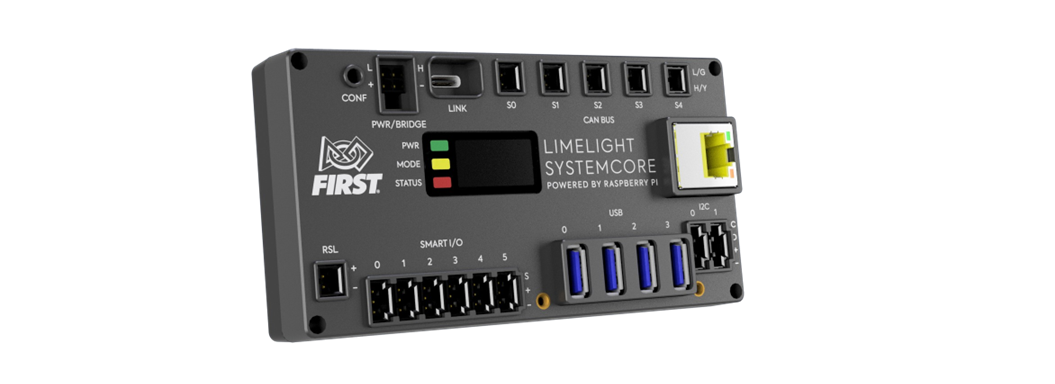
Rendering of the current design of the Systemcore device
Based on testing and findings from the first wave of alpha test teams this summer, there have been a few modifications to the Systemcore hardware details to improve performance and team experience. Finding these issues is the point of the alpha test process, and FIRST Tech Challenge alpha teams will receive units with these improvements included. While most of these changes are minor updates to fix small issues or improve robustness, one team-facing change is to the connectors; the Weidmueller Power Input connector is being removed, both programs will utilize the Bridge Port Molex Microfit+ to power the device, and the CAN connectors are being changed to 2 pin Molex SL connectors. Other changes include the addition of a configuration button and changing the I/O to pull-up instead of pull-down in digital mode. As a reminder, there are more Systemcore product details in previous blog posts (see Updates on the Future Robot Controller and SystemCore Alpha Testing – First Wave).
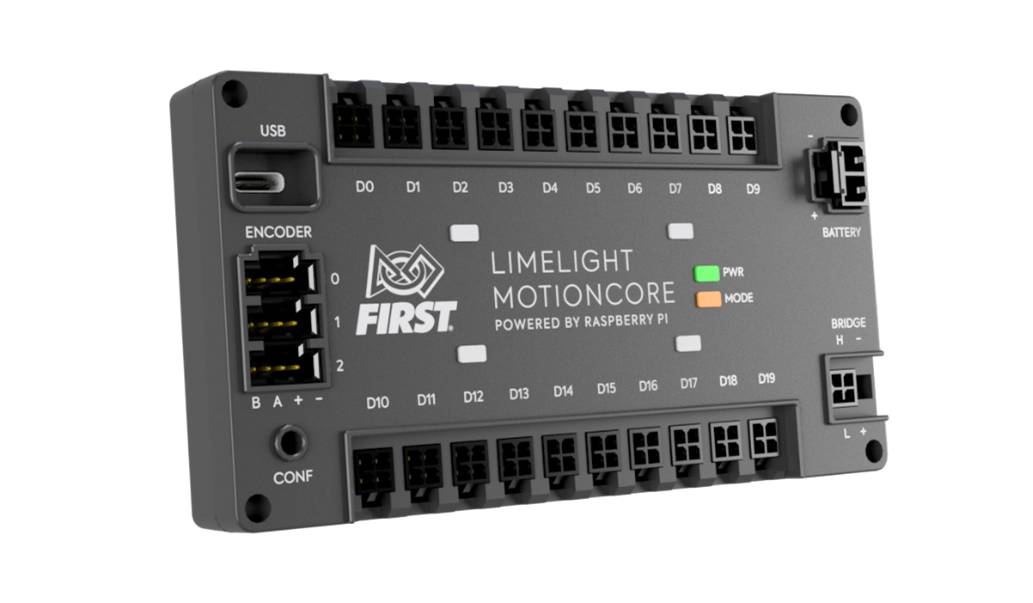
Motioncore is a communication (CAN) and power distribution board with a few other key features. Teams will power the Motioncore from their battery dock and then pass power and CAN communication back to their Systemcore using the bridge port (4-pin Molex Micro-Fit+).
Introducing CAN to FIRST Tech Challenge opens a new world of possibilities for communication to the FIRST A301 brushless motor and smart sensors. CAN is an industry standard communication protocol and has been used in FIRST Robotics Competition since 2010. CAN enables high-speed two-way communication between devices and is intended to largely replace the need to use I2C for sensors, which has some significant technological drawbacks.
Looking at what we learned from CAN in FIRST Robotics Competition, one of the biggest frustrations with using CAN communications is complex daisy-chain wiring and troubleshooting multiple connections and devices when something goes wrong. Motioncore is designed to make using CAN simple and plug-and-play so teams can spend more time solving game challenges, not chasing down wiring problems. Motioncore has 20 individual “Device” (1Mbps CAN + Power) ports (4-pin Molex Micro-Fit+) for point-to-point wiring to FIRST A301 actuators or sensors and 3 quadrature encoder ports (4-pin Molex SL) for robot odometry or other sensing. Motioncore communicates with Systemcore via higher speed CAN FD, providing plenty of bandwidth for fast device updates.
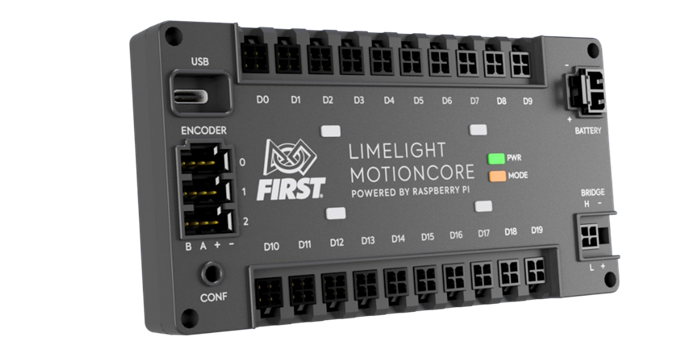
Rendering of the current design of the Motioncore device
Like Systemcore, Motioncore is designed to help take the risk out of doing the basics. New teams and new team members can build with confidence knowing Limelight and FIRST have done everything possible to lower the risk of accidental damage.
Overview of additional Motioncore features:
The FIRST A301 is a smart brushless motor which will eventually replace all other actuators (motors and servos) in the FIRST Tech Challenge program. This actuator was created through direct collaboration between FIRST® and REV Robotics, with input from other vendors, to simplify robot design, increase competitive parity, and raise reliability across the program.
The A301 replaces the scattered landscape of FIRST Tech Challenge motors and servos with one unified, high performance actuator solution. More details about the FIRST A301 will come out in a follow-up blog post tomorrow.
While we are not ready to release details, we are happy to share some of what is most exciting about this new direction. The current NiMH battery technology used in FIRST Tech Challenge is commonly available, but to ensure safety and equity in our sport we have limited the legal batteries to a small number of options from a limited set of vendors. This can make it difficult for international teams, or teams with strict purchasing requirements, to be able to purchase a legal battery. While NiMH is a very safe and stable battery chemistry, the cases (shrink wrap) are not robust enough for our use case and this chemistry has a relatively high internal resistance making it poorly suited for high current draw situations, like on your robot.
Conversely, power tool batteries are commonly available everywhere FIRST Tech Challenge teams are, they come in rugged cases that are designed to survive some rough handling, and they use a chemistry designed for high load applications. Power tool batteries are about the same price point as the current legal batteries and some teams will already own them. We are designing around 18V(5S) packs which have a higher voltage than today’s batteries. This means that some existing 12-volt devices, such as some sensors, won’t work without voltage regulators, but it also has benefits such as lowering the overall robot current draw and giving robots more headroom to operate before they enter a brownout state.
As with our current system, FIRST will test and publish specific brands and models of battery that are legal for use in competition. Stay tuned for future updates.
As mentioned above, we have not yet focused on the future of the Driver Station Device. For alpha testing purposes, teams will use a desktop computer application to control their robot. This application is cross platform compatible and will run on most modern Windows, Linux, and macOS systems. Minimum specs for this application are fairly low, with the existing FIRST Robotics Competition Kit of Parts Laptop (HP 14-dq6011dx) being the baseline. All of the existing FIRST Tech Challenge legal gamepads will be supported, with the PlayStation DualSense having the best support across all platforms. The application is still being developed by the WPILib team, and more information will be available at a later date.
The FIRST Tech Challenge alpha testing application closed on 11/14, but we recognize this might be a bigger scope of testing than teams originally planned for when they applied. We will confirm with chosen Alpha test teams that they are still willing to be testers with this additional scope. Alpha test teams will be asked to test both the hybrid solution, using Systemcore with existing batteries, motors and REV Expansion Hubs and will also test the new system in its entirety including the FIRST A301 actuators. We will announce alpha test teams in a future blog post. We previously announced the list of FIRST Robotics Competition alpha test teams. Even if your team is not chosen, you can follow-along with project progress on the Systemcore Alpha Test Github Project.